
Economy is the price of every kilometre.
The short version
Running economy is how much oxygen you need to cover a kilometre at a given pace. Two runners with the same engine can differ a lot in it. With better economy, marathon pace takes a smaller share of your VO2max and sits further below your thresholds. Economy improves with years of consistent running, and strength training and strides speed that up.
Two runners line up with the same VO2max, and both can race a marathon at the same share of it. On paper, they’re equal. One of them finishes about ten minutes ahead.
The difference is running economy: how much oxygen each of them needs to cover a kilometre at the same pace. Think of fuel consumption in a car. The engines are the same size, but one goes further on a litre.
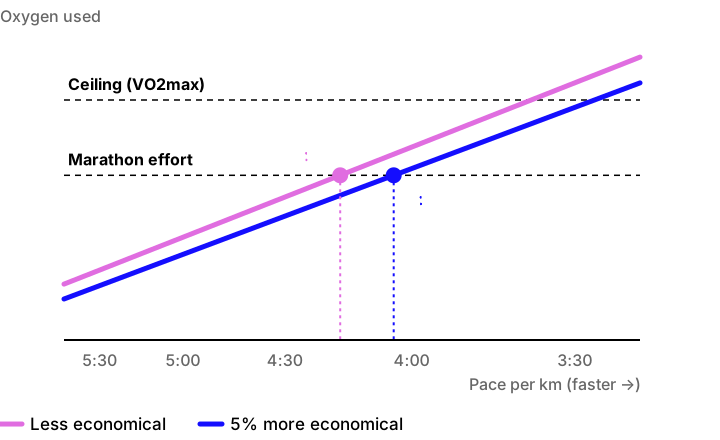
Illustrative. Two runners with the same VO2max, one of them using 5% less oxygen at every pace. At the same marathon effort, that’s 4:04 per kilometre instead of 4:16, about eight and a half minutes over the full distance.
Where the savings come from
Some of your economy comes with your build, from your body size to the length of your legs. Much of it can be trained.
Your tendons and muscles store energy when your foot lands and give it back when you push off, like a spring. Stronger, stiffer springs give back more. That’s why strength training, especially with jumps, improves economy. Strides and short hill sprints teach your nervous system a fast, relaxed stride, and that carries over to slower paces too.
Shoes play a part as well. Modern racing shoes with springy foam and a stiff plate save many runners a few percent of oxygen at the same pace.
The biggest factor is time. Years of steady running make your stride smoother and cheaper in ways no single session can.
A cheaper stride lowers the cost of every pace.
Why it matters most late in the race
Economy gets worse as you tire. After a few hours, your stride shortens, the springs lose some of their snap, and the same pace costs more oxygen. A runner who starts with a cheaper stride has more margin before that rising cost catches up. How well you hold on to that margin over the full distance is your fatigue resistance.
Sample sessions
- Strides: after an easy run, 3 to 6 × 8 to 12 seconds, fast but relaxed. Walk or jog back slowly between them, with full recoveries.
- Hill sprints: 6 to 8 × 10 seconds up a steep hill at effort 10. Walk back down, with full recoveries.
- Strength: twice a week, as in Strength work keeps you running, plus a few sets of jumps.
None of these should leave you tired. They train your nerves and springs, and your engine hardly notices them.
All seven workout types are on the Method page.
In your training
- Add strides after a few easy runs a week, 3 to 6 relaxed accelerations of 8 to 12 seconds.
- Keep running consistently. Economy keeps improving over years of steady training.
- Do strength training twice a week, with some jumps. It makes each stride cheaper.
Want this built into your own training? Let’s talk it through.
Book a free intro call