
Pace is the output. Effort shows the cost.
The short version
Every run falls into one of three intensity domains, easy, moderate or hard, and two markers in your body draw the lines between them. Those markers stay put, but the pace that matches them changes with your sleep, your stress, the heat and the hills. Effort moves with the day, so train by effort and use pace and heart rate as a check.
On Tuesday, your easy pace feels effortless. On Thursday, after a short night and a long day at work, the same pace feels like a race. Your fitness hasn’t changed in two days. Your day has.
Three domains
Two markers in your body, the aerobic threshold and the lactate threshold, split your running into three intensity domains. In each domain your body works differently, so each one does a different job.
| Domain | Effort | How it feels | Typical runs |
|---|---|---|---|
| Easy | 1–4 | Relaxed, you can talk in full sentences. Fatigue builds very slowly. | Easy runs, recovery, most of the long run |
| Moderate | 5–7 | Steady to comfortably hard, short sentences. You’re working, but still in balance. | Steady runs, marathon pace, threshold |
| Hard | 8–10 | Hard to near max, talking is a struggle. Fatigue builds within minutes. | Intervals, short reps |
Effort is your score on the Moonshot scale from 1 to 10. The step from 4 to 5 is your aerobic threshold: your breathing deepens and easy stops being easy. A 7 is roughly your lactate threshold, the line between moderate, which you can sustain for a long time, and hard, which comes to an end relatively quickly.
Most of your running belongs in the easy domain. That’s where the engine is built, and it leaves you fresh for the sessions that matter. Marathon pace sits in the moderate domain, for most runners towards its lower end. Hard running works, in small doses.
Why effort, not pace
Pace is the output, what you see on your watch. Effort reflects what’s happening inside to produce it: which systems are working, and how hard. That’s why effort tells you which domain you’re in, and pace can’t.
Your thresholds sit in your body, and the pace that matches them changes every day: with your sleep, your stress, the rest of your life, the heat, the wind, the hills and the sessions earlier in the week.
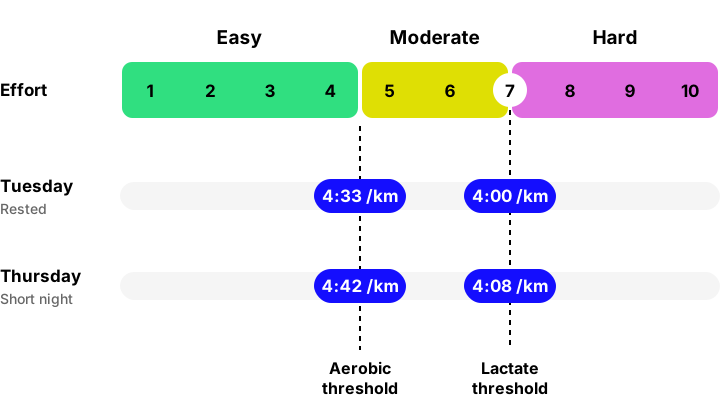
An illustrative example for a runner aiming for 3:00, not real data. The domains stay where they are on the effort scale. The pace that matches each threshold moves with the day.
Chase a fixed pace on a bad day, and an easy run drifts into moderate and a hard session gets harder than planned. Effort moves with the day, so it keeps you in the right domain.
Your thresholds don’t live on your watch.
Pace and heart rate are still a useful check. Pace stops you drifting too fast on good days, and heart rate shows when heat or fatigue pushes the cost up. But GPS jumps around and heart rate lags, so use them to check your effort.
Learn your markers
Effort is a skill. Log it after every run, and over the weeks you start to feel where your thresholds are without looking at your watch. On race day, that’s what stops you from starting too fast.
In your training
- Run each session at the effort in your plan, with pace and heart rate as a check.
- Keep most of your running easy, at effort 2 to 4.
- On a bad day, keep the effort and let the pace go. On a great day, keep the effort too.
- Log your effort from 1 to 10 after every session in Final Surge.
Want this built into your own training? Let’s talk it through.
Book a free intro call