
Your life is part of your training load.
The short version
Your body has one recovery budget. A deadline, a short night or a long flight draws from it just like an interval session does. Plan around the busy weeks you can see coming. In the ones you can’t, keep running, but keep it short and easy.
Your training log shows every kilometre you ran this week. It doesn’t show the deadline or the night your toddler woke at three. Your body counts those too.
One recovery budget
Your body doesn’t keep separate accounts for training and the rest of your life. A hard interval session, a tough week at work and a broken night all draw on the same capacity to recover.
That’s one reason runners respond so differently to the same training. Research points to sleep, life stress and recovery as part of the answer: people under high mental stress tend to get less fitness out of the same work.
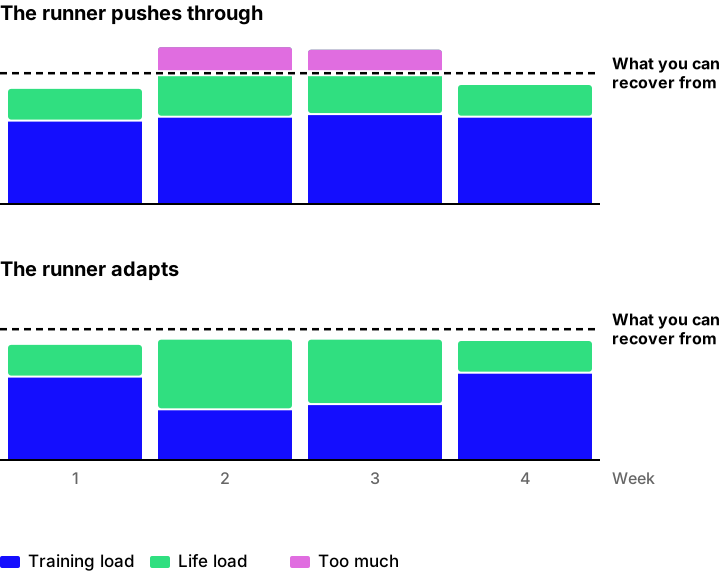
An illustrative example, not real data. Life gets busy in weeks two and three. The runner who pushes through goes over what they can recover from. The runner who adapts trains less for those two weeks and stays below.
Where the load comes from
- Work. Long days, deadlines and mental fatigue, even when you sit still all day.
- Sleep. The most direct one. Short or broken nights mean less repair and harder sessions.
- Family. Small children, caring for others, and very little time to yourself.
- Travel. Time zones, long flights or drives, and routines that fall apart.
- Illness and worry. A cold coming on, a difficult period, a lot on your mind. They count too.
Keep your plan and your life in sync.
A session beats no session
A busy week is not a reason to stop running. A short, easy run often does more good than skipping: it keeps the habit going, and it can be the calmest half hour of a hectic day.
What changes is the kind of session. In a heavy week, running should relax you, not strain you. Swap the hard session for an easy one, shorten it, or move it to a calmer day.
Plan for it
Some busy weeks you can see coming: a deadline, a holiday, a work trip. Those go into the plan in advance, with the hard sessions placed around them. Others arrive without warning, and that’s where flexibility matters. The sooner your coach knows, the easier it is to adjust.
It works both ways. The plan makes room for your life, and your life makes room for the training: fixed run days, a bag packed for the trip, an early night before the long run.
In your training
- Tell me about busy weeks, trips and short nights as early as you can.
- In a heavy week, keep running, but keep it short and easy.
- After a bad night, swap a hard session for an easy one, or move it to a calmer day.
- A run should leave you calmer than before. If it doesn’t, it was too much for that day.
- Protect your key sessions: fixed run days, and an early night before the long run.
Want this built into your own training? Let’s talk it through.
Book a free intro call