
Fitness is built in the recovery.
The short version
A key session doesn't make you fitter on the day. It makes you tired, and in the days after, your body rebuilds a little stronger. Get the dose right and time the next hard session for when you've come back up, and the gains stack. Too easy, and little changes. Too hard or too soon, and every session starts a bit lower than the last.
You finish a good threshold session and feel strong. Yet at that moment, you’re less fit than you were this morning. Your muscles are low on fuel, there’s small damage in the fibres, and your body is busy cleaning up. The fitness that session was for arrives later, while you recover.
Stress, then repair
Every session that pushes your body beyond what it’s used to sets off the same chain. First comes fatigue: for a while, you can do less than before. Then comes recovery, as your body refuels and repairs. If the dose was right, it doesn’t stop at the old level. It rebuilds a little stronger, ready for the next time the same stress comes along. Sport scientists call that overshoot supercompensation.
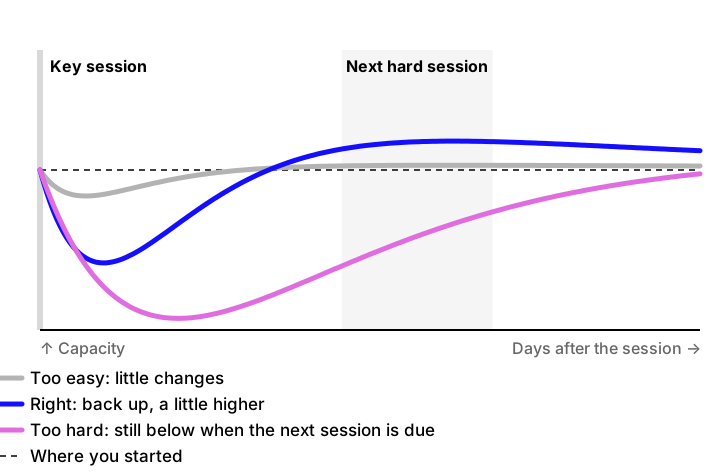
A simplified model, not real data. The right dose dips, recovers and ends up higher than where you started. Too easy barely changes anything. Too hard digs so deep that you’re still below the line when the next hard session is due.
The dose
A key session that never really challenges you gives your body no reason to change. One that goes too deep takes days longer to recover from than planned, so the next session starts below the line.
This is about the hard sessions in your week. Easy runs work differently: each one is a small stimulus, and they add up through volume over months.
The next hard session should start from higher ground.
The timing
The overshoot doesn’t last forever. Wait too long, and you slide back to where you started. Come back too soon, and you start the next session still in the hole, and each one digs you a little deeper.
The rhythm of a training week is built around this. Hard days are spaced apart, with easy days in between that keep you moving while the repair happens. Week after week, the small gains stack up.
Different parts recover at different speeds
The single curve is a simplification. Your body is many systems, and each recovers at its own pace. Fuel stores refill in a day or two. Muscle damage from a long run or a hard downhill takes several days. Tendons and bones adapt slowest of all.
So you can feel ready while part of you isn’t. That’s why a plan spaces sessions by what they stress, and why how you feel is only part of the answer.
In your training
- Leave at least one easy day between hard sessions, and often two.
- After a race or a very hard session, give yourself more recovery than you think you need.
- Sleep and food are part of the recovery. A short night slows the repair.
- If you start hard sessions tired week after week, tell me. Then the dose or the spacing needs to change.
Want this built into your own training? Let’s talk it through.
Book a free intro call