
Your heart adapts faster than your tendons.
The short version
Your heart, lungs and blood adapt to training within weeks. Your tendons and bones need months. So fitness can outrun what your body can structurally handle, and that gap is where many running injuries come from. Build volume gradually and take the lighter weeks seriously, so the slow tissues can catch up.
Week four of a new build. Your breathing feels easy, the sessions are going well and the long run felt short. You’re ready for more, so you add a few kilometres here and there. Two weeks later, your Achilles starts to complain.
The cause is usually timing.
Your body adapts at different speeds
Training triggers adaptations all over your body, but not all at the same pace. Your blood, your heart and the engine inside your muscles, the mitochondria and capillaries, respond within days to weeks. Your tendons and bones need months.
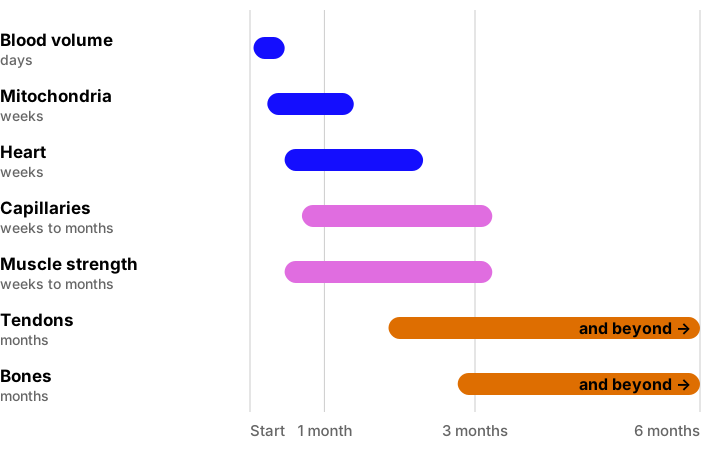
Rough timescales, not exact values, and they vary between runners.
So after a few good weeks, your engine is ready for more, while your Achilles, shins and feet are still catching up. Your fitness has outrun your structure.
Your heart decides what you can do. Your tendons decide how fast you can build.
Why injuries come when you feel best
This is why so many running injuries arrive when you feel fit rather than tired. Achilles and calf problems, shin pain and stress reactions often follow a period of training that felt great, with volume or intensity going up a little too quickly.
Feeling fit tells you about your heart and lungs. It tells you very little about your tendons and bones. They don’t send a clear signal until they’re already overloaded.
Build, then step back
That’s why the plan builds gradually, even when you feel you could do more. And it’s why every third or fourth week is lighter. In a lighter week, the slow tissues catch up with the fast ones, and fatigue clears so the next block lands on a fresher body.
Lighter doesn’t mean doing nothing. Volume drops, a little intensity stays, and you come out of it ready to build again. Don’t fill the gap with extra kilometres.
Robust takes years
Tendons and bones do get stronger. They just do it slowly. A body that has handled consistent training for years can take far more than one that was pushed hard for a few months. Strength work helps too: it loads tendons and bones in a controlled way and makes them more robust to the miles.
In your training
- Build volume gradually, even when you feel ready for more.
- Every third or fourth week is lighter by design. Don’t make up the missing kilometres.
- Take a niggle in your Achilles, shins or feet seriously, and tell me early.
- Keep up your strength work. It makes tendons and bones more robust.
Want this built into your own training? Let’s talk it through.
Book a free intro call