
Five things set your marathon pace.
The short version
Your marathon pace comes from one engine with five parts. VO2max is its size. Your lactate and aerobic thresholds decide how much of it you can use for hours. Economy turns that oxygen into pace. Fatigue resistance decides how much is still there after 30 kilometres. Because the parts multiply, a 5% gain in any one of them is worth about the same, and training works on all of them.
A 3-hour marathon means 4:16 per kilometre, held for 42 kilometres. Five things in your body decide whether you can do that. Each of them has its own note. This one shows how they work together.
One engine, five parts
Endurance performance comes down to one simple equation. How much oxygen you can use, times the share of it you can hold for hours, divided by what each kilometre costs, gives your race pace. The equation comes from physiologist Pietro di Prampero; Michael Joyner and Edward Coyle made it the standard picture of endurance performance. Fatigue resistance was added more recently, as a fourth factor.
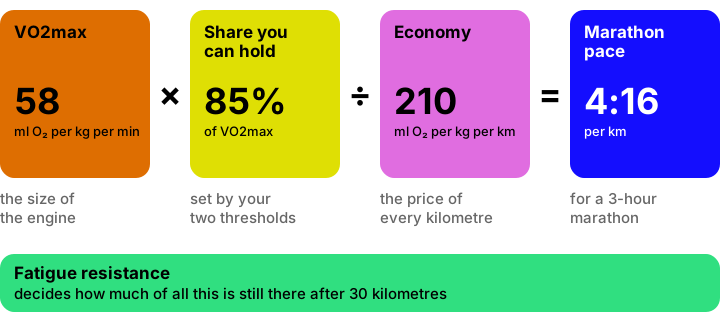
Illustrative, rounded numbers for a runner with a 3-hour marathon.
- VO2max is the size of the engine. It’s the most oxygen your body can use in a minute. For our runner, that’s 58 millilitres per kilogram of body weight.
- Your lactate threshold sets how much of it you can hold. Marathon pace sits just below it. Our runner races at about 85% of their VO2max.
- Your aerobic threshold decides what that share costs in fuel. The higher the top of easy, the more of your marathon pace runs on fat, and the longer your carbohydrate lasts.
- Economy is the price of every kilometre. It turns oxygen into pace. Our runner uses 210 millilitres of oxygen per kilogram for every kilometre.
- Fatigue resistance decides how much is left in the last hour. All four numbers above are measured on fresh legs. A marathon asks for them after two or three hours.
All five rest on the aerobic system inside your muscle fibres, the mitochondria that make almost all the energy you use in a marathon.
Your marathon pace is what the five parts add up to.
They multiply
Because the parts multiply, a 5% gain in any one of them is worth about the same. For our runner, that’s eight to nine minutes over the marathon.
| Part | A 5% gain | Marathon |
|---|---|---|
| None | 3:00 | |
| VO2max | 58 → 61 | about 2:51 |
| Share you can hold | 85% → 89% | about 2:52 |
| Economy | 210 → 200 ml per kilometre | about 2:51 |
Fatigue resistance works differently. It doesn’t make you faster on fresh legs, it decides whether you keep your pace. Slowing by 30 seconds per kilometre over the last 10 kilometres costs five minutes, whatever the other four parts look like.
Where the room is differs from runner to runner. In your first years, all five improve quickly. After that, VO2max tends to level off, while the thresholds, economy and fatigue resistance keep improving for years. That’s why a marathon plan spends most of its time below threshold, and only a small part on intervals.
What it means for your training
Every session works on one or two parts, and the week brings them together. That’s why every run has a purpose.
| Session | Works on |
|---|---|
| Easy runs | Aerobic threshold, mitochondria |
| Long runs | Aerobic threshold, fatigue resistance |
| Threshold sessions | Lactate threshold |
| Intervals | VO2max |
| Strides, hills and strength | Economy |
| Marathon pace late in a long run | Fatigue resistance |
All seven workout types are on the Method page.
In your training
- Every session in your plan works on one or two of the five parts. The mix over the week is what builds the whole engine.
- Judge your progress on all five, not on one number like the VO2max estimate on your watch.
- Give the slow parts time. Thresholds, economy and fatigue resistance keep improving for years, long after VO2max levels off.
Want this built into your own training? Let’s talk it through.
Book a free intro call