
Every run has a purpose.
The short version
Every session in your plan targets one intensity domain, and each domain builds something different. Easy running builds your aerobic engine, moderate running raises your thresholds, hard running lifts your ceiling. Know the purpose before you start, and run the effort that serves it.
The plan says 50 minutes easy. The sun is out, your legs feel good, and by the end you’re running a little faster than easy. It felt like a good run. But it was too hard to be easy and too easy to be a workout, so it didn’t do the job it was in the plan for.
Each domain builds something different
Your running falls into three intensity domains, and your body responds to each one in its own way.
| Domain | Effort | What it builds | Typical sessions |
|---|---|---|---|
| Easy | 1–4 | More capillaries and mitochondria, better fat burning, a stronger heart. Tendons and bones get used to the load. | Easy runs, recovery runs, most of the long run |
| Moderate | 5–7 | Higher aerobic and lactate thresholds. You learn to hold race pace for longer. | Steady runs, marathon pace, threshold |
| Hard | 8–10 | A higher VO2max and more speed. Better economy at fast paces. | Intervals, short hill reps |
So every session has a job. An easy run builds the engine and keeps you fresh for tomorrow. A threshold session pushes your lactate threshold up. Intervals raise your ceiling. The long run builds durability for the last ten kilometres.
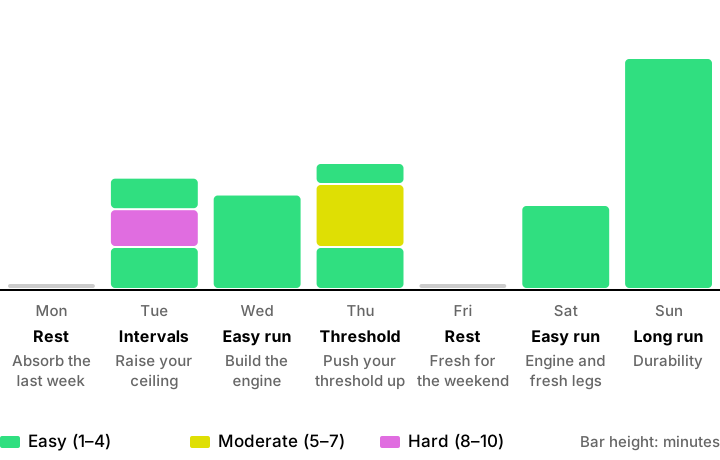
An illustrative week, not a real plan. Even the hard sessions are mostly easy running, with one focused block in the middle. Every day has its own job.
The purpose decides the effort.
The trouble with in between
When an easy run drifts into moderate, you get a little of what moderate running builds, and you pay for it in fatigue. The next hard session starts on tired legs, so it ends up less hard than planned. Do that a few times a week and all your running slides towards the middle: easy days stop being easy, and hard days stop being hard enough.
Most well-trained endurance athletes do the opposite. The bulk of their running is clearly easy, a smaller part is clearly hard, and every session has a clear purpose.
Know the job before you start
Read the session before you lace up. Which domain is it in, and what is it for? Knowing that makes it easier to hold back on an easy day and to commit on a hard one.
It also tells you what to keep when a session has to change. On a tired day, an easy run can simply get shorter. A threshold session is better moved to tomorrow than run at half effort today, because its purpose only works in its own domain.
In your training
- Before each session, check which domain it is in and what it is for.
- On easy days, stay at 2 to 4, even when you feel great.
- On hard days, commit to the effort in the plan.
- If a session has to change, keep its purpose. Shorten it or move it, rather than turning it into something in between.
Want this built into your own training? Let’s talk it through.
Book a free intro call