
The marathon starts at 32 kilometres.
The short version
Most marathons are decided in the last ten kilometres, and long runs prepare you for them. Plan them by time, not distance, up to about two and a half hours. In the marathon block, add sections at marathon pace, so you learn to hold race pace when you’re already tired.
Ask any marathoner where their race was decided, and the answer is rarely the first half. It’s somewhere after 30 kilometres, when the legs get heavy, the pace starts to slip and the mind starts negotiating. The long run is where you prepare for exactly that moment.
What a long run builds
A long run trains things no other session can:
- Your legs. Muscles, tendons and bones get used to hours of impact, so they hold their form late in the race.
- Your engine. More time at easy effort means more capillaries and mitochondria, and a body that burns more fat and saves carbohydrate for later.
- Your head. You learn what hours on your feet feel like, and that you can keep going when it gets uncomfortable.
Together, that’s durability: how much of your fitness is still there after hours of running. Two runners with the same 10K time can be minutes apart in the marathon. The difference is usually made in the last ten kilometres.
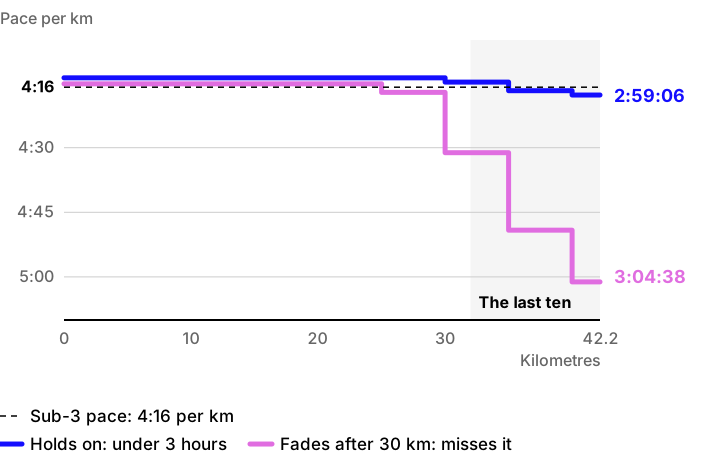
An illustrative example, not real data. Two runners with the same 10K time both go for under three hours and run together for 30 kilometres. One holds on and makes it. The other slows a little more with every split, loses over five minutes in the last twelve kilometres and misses it.
You don’t train for the first 32 kilometres. You train for the last ten.
First easy, then specific
The foundation of durability is built at easy effort, 2 to 4 on the Moonshot scale. That’s also what lets you recover in a day or two rather than a week, so the rest of your training keeps going. Build the long run gradually over the weeks, with lighter weeks in between.
Longer isn’t always better. Beyond about two and a half hours, the extra benefit shrinks while fatigue and injury risk keep climbing. That’s why the long run is capped by time, not distance: a runner heading for 4:30 doesn’t need to run 35 kilometres in training to be ready.
In the marathon block, the long run gets more specific: sections at marathon pace, often late in the run, teach you to hold race pace when you’re already tired. That’s when the last ten kilometres really get trained. Those marathon-block long runs deserve their own note.
In your training
- Run most of your long run at easy effort, 2 to 4 on the Moonshot scale.
- Build it gradually, and keep it to roughly two and a half hours at most.
- In the marathon block, expect sections at marathon pace, often late in the run.
- Keep the day after easy, or take it off.
Want this built into your own training? Let’s talk it through.
Book a free intro call