
Raise the top of easy.
The short version
Your aerobic threshold is the top of easy, the fastest pace at which lactate stays close to resting levels and fat still covers much of the energy. Below it, you can keep going for hours. Months of patient, consistent easy running push that line up, and every pace above it, marathon pace included, gets cheaper.
Take a runner who runs a 3-hour marathon. Their easy pace is somewhere between 4:55 and 5:25 per kilometre, their marathon pace 4:16, and they can hold 3:40 for a few minutes at most. Less than two minutes per kilometre separates these paces. Yet one can be held for hours, and another for barely five minutes.
That’s because your body doesn’t respond to speed in a straight line. It changes character at two thresholds. This note is about the first one.
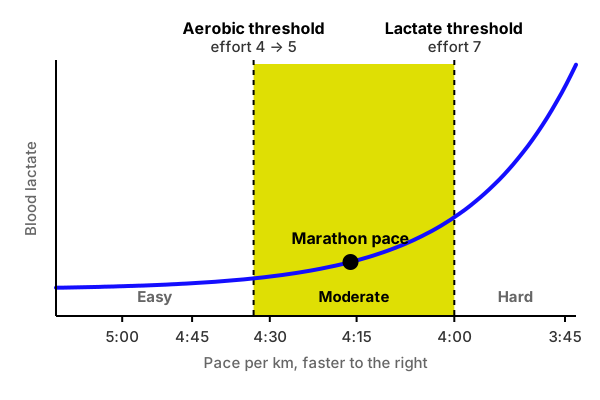
Illustrative, for a runner with a 3-hour marathon. Lactate stays low through easy running, starts to rise at the aerobic threshold, and climbs steeply past the lactate threshold. Marathon pace sits in between.
What happens below the line
At easy pace, your muscles produce a little lactate and clear it just as fast. Much of the energy comes from fat, and even a lean runner carries enough of it for many hours. Breathing is calm, and fatigue builds so slowly that you could keep going for a very long time.
Around 4:30 to 4:35 per kilometre for our runner, that changes. Lactate starts to rise above resting levels, the body turns to more carbohydrate, and breathing deepens. That’s the aerobic threshold. On the Moonshot effort scale, it’s the step from 4 to 5, where easy ends and moderate begins.
Why it matters for the marathon
Carbohydrate is the fuel you can run out of. Above the aerobic threshold, you burn more of it with every step up in pace, and a marathon is long enough to empty the tank. The closer your marathon pace sits to this line, the more of the race runs on fat, and the more carbohydrate is left for the last ten kilometres.
The higher the top of easy, the less every faster pace costs.
How to raise it
The aerobic threshold moves when your slow-twitch fibres change, the ones that carry you through easy running. Easy running grows more capillaries around them, so more oxygen reaches the muscle, and more mitochondria inside them, the small power plants that burn fat and carbohydrate with oxygen. With more of both, those fibres can carry a faster pace on their own, before your body has to call on carbohydrate and on faster fibres. The line moves up.
Four things in your training drive that change:
- Easy volume. Your total easy running over the week is the main signal. Add one run, or 10 to 15 minutes to a few runs, then hold that level for a few weeks before you add again.
- The long run. Running low on stored carbohydrate is one of the strongest signals for slow-twitch fibres to adapt. They’re so well adapted already that only long runs get them there; a short, hard session drains your faster fibres instead. Build the long run towards two to two and a half hours at easy effort.
- Time at the top of easy. Longer stretches at effort 4, just below the line, train it directly. For our runner that’s about 4:35 to 4:55 per kilometre. Once a week is plenty.
- Months of it. The changes take months, and they keep building for years. The runner who keeps this going through the whole winter starts the spring build with a higher line.
That’s also why easy days stay easy, even when you feel ready for more. An easy run that drifts above the line doesn’t raise it faster. It adds fatigue that the next session has to carry.
Runners who train hard most of the time often find their easy pace surprisingly slow. Their fast side got strong while the aerobic side fell behind. The way out is more easy running, and patience.
You’ll notice the line moving before anyone measures it. The same easy effort gets a little faster, or each heartbeat carries you a little further. A long steady run where your heart rate barely drifts in the second half is a good sign the line sits higher than it did.
Sample sessions
- Easy run: 40 to 75 minutes at effort 2 to 4. You could hold a full conversation the whole way.
- Top of easy: 60 minutes, with the middle 20 to 30 minutes at a 4, right at the top of easy.
- Long run: 90 minutes to two and a half hours at 2 to 4, built up over the weeks.
Most weeks are mainly the first and the last. The top-of-easy run is an occasional step up, when the plan asks for it.
All seven workout types are on the Method page.
In your training
- Keep easy runs at effort 2 to 4, so they stay below the line.
- Build your volume slowly and keep it going for months. This threshold rises with time more than with hard days.
- Top-of-easy runs at a 4 sit right at the line. Run them when the plan says so, and keep your other easy days easy.
- Check your easy pace now and then. When the same effort gets faster, the line has moved.
Want this built into your own training? Let’s talk it through.
Book a free intro call