
Your marathon runs on mitochondria.
The short version
Your muscles run on ATP and store only a few seconds' worth, so they keep making more in three ways. Phosphocreatine is instant but empties in seconds. Glycolysis is fast but limited, and makes lactate. The aerobic system, in your mitochondria, is slower but can run for hours on fat and carbohydrate. A marathon gets over 99% of its energy from that last one, so nearly all your training builds it.
A sprinter in a 100-metre final and our 3-hour marathoner in the last kilometres of a marathon run on the same fuel. Every muscle contraction is paid for with a molecule called ATP. What differs is how their bodies make it.
Three ways to make ATP
Your muscles hold only a few seconds’ worth of ATP, so they make new ATP all the time. They have three ways to do it.
Phosphocreatine sits ready in the muscle and turns into ATP instantly. It delivers the most power of all, and it’s empty after about ten seconds. It’s what you use in a sprint, a jump or the first steps up a steep hill.
Glycolysis breaks down carbohydrate quickly, without oxygen. It splits each glucose molecule into two smaller ones, called pyruvate, and gains two ATP along the way. It’s fast, but it only uses carbohydrate and yields little ATP per molecule. It leads in hard efforts of about half a minute to two minutes.
When glycolysis runs faster than your mitochondria can take in the pyruvate, the surplus is turned into lactate. That lactate isn’t waste. It moves to neighbouring fibres, your heart and your liver, which turn it back into pyruvate and burn it with oxygen. Only when you make it faster than your body can clear it does it pile up, at your lactate threshold.
The aerobic system works with oxygen, inside the mitochondria, the small power plants in your muscle fibres. It’s the slowest of the three, but it gets around fifteen times more ATP out of the same carbohydrate, it can burn fat as well, and it keeps going for hours.
All three always work together. Which one leads depends on how hard and how long you run.
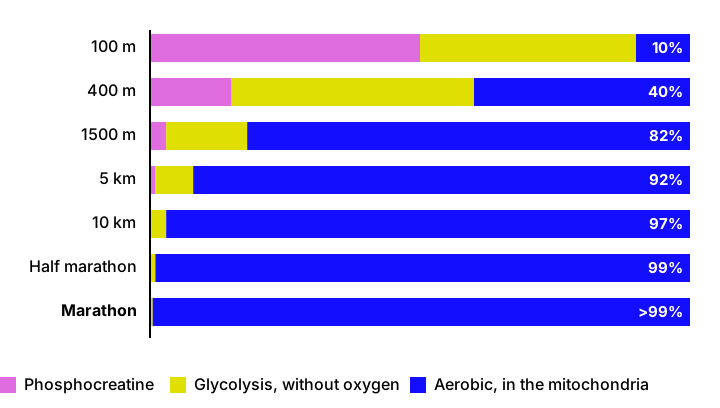
Illustrative, rounded from studies of trained runners. The longer the race, the larger the aerobic share. In a marathon, it’s over 99%.
Why the marathon is almost all aerobic
Over two to five hours, the fast systems can’t keep up. Phosphocreatine empties in seconds, and glycolysis on its own would bring you to a halt within minutes. So a marathon comes down to two things: how much ATP your mitochondria can make per minute, and how long the fuel lasts.
That fuel is a mix of fat and carbohydrate. Fat is nearly unlimited, but it needs more oxygen per unit of energy, so it can’t carry a fast pace alone. Carbohydrate is quicker to use but limited, enough for roughly 90 minutes to two hours of hard running. The fitter your aerobic system, the more fat it burns at the same pace, and the longer the carbohydrate lasts.
A marathon is won in the mitochondria.
What it means for your training
Building the aerobic system is the main job of a marathon build. Easy runs and long runs grow more mitochondria and more capillaries around them, which is what raises the top of easy. Threshold sessions and intervals work the same system closer to its limits, and raise your threshold and your ceiling.
The fast systems still have a small role. Short sprints of ten seconds train power and a quick, relaxed stride, and they hardly tire you. Long, all-out efforts that lean on glycolysis cost a lot of recovery and build little that a marathon needs.
Sample sessions
- Aerobic, the base: 60 to 90 minutes easy at effort 2 to 4, and a weekly long run.
- Aerobic, near its limit: 3 × 10 minutes at effort 7, with 2 minutes of easy jogging between.
- Phosphocreatine: 6 to 8 × 10 seconds up a steep hill at effort 10, with a recovery walk back down.
All seven workout types are on the Method page.
In your training
- Most of your week is easy running, because it builds the system that powers your race.
- Long runs grow your mitochondria and teach them to burn more fat.
- Short sprints with full recovery train power and form without much fatigue.
- Long, all-out efforts of one to two minutes have little place in a marathon build.
Want this built into your own training? Let’s talk it through.
Book a free intro call