
Your threshold sets your marathon pace.
The short version
The lactate threshold is the fastest pace at which your body still clears lactate as fast as it makes it, roughly what a trained runner could race for an hour. Above it, fatigue arrives within minutes. Your marathon pace sits at a steady share below it, so when the threshold rises, marathon pace rises with it at the same effort. You move it from two sides: easy running makes you produce less lactate, and controlled threshold work teaches your body to clear more.
Lactate has a bad name among runners, as the waste that makes your legs burn. Yet your muscles make it all the time, even at rest, and other muscle fibres, your heart and your liver burn it as fuel.
It only becomes a problem when you make it faster than you can use it. Above the top of easy, the first threshold, lactate starts to rise a little, but your body still clears it fast enough to settle at a new, steady level. Run faster still and you reach a second line, where clearance can no longer keep up. Beyond it, lactate piles up in your blood along with the other by-products of hard work, breathing gets hard, and fatigue that took hours to build now arrives within minutes.
That second line is the lactate threshold. A well-trained runner could race at it for about an hour. Newer runners last closer to 30 or 40 minutes. For our runner with a 3-hour marathon, it sits at about 4:00 per kilometre, a 7 on the effort scale.
Marathon pace hangs from it
You can’t run a marathon above your lactate threshold, because you’d last an hour at most. So marathon pace sits below it, and for most runners at a fairly steady share. Faster runners race at around 92 to 97% of their threshold speed. Runners who are out on the course for longer race at a bit less. For our runner, marathon pace is 4:16 per kilometre, or 94%.
That share changes slowly. The threshold itself can move within weeks, and when it rises, marathon pace rises with it.
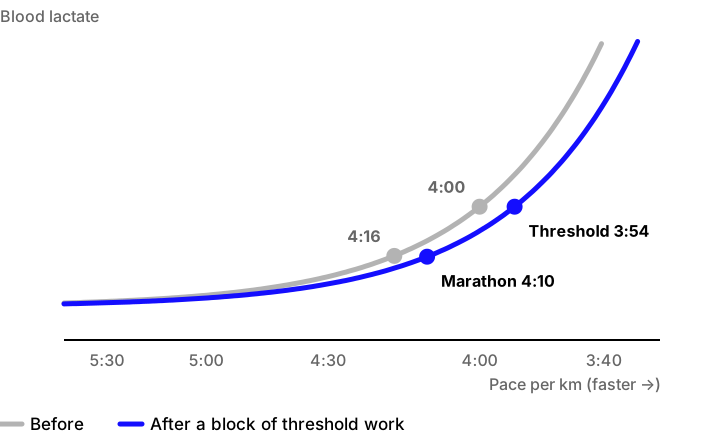
Illustrative. After a block of threshold training, the lactate curve shifts towards faster paces. The threshold moves from 4:00 to 3:54 per kilometre, and marathon pace at the same effort from 4:16 to 4:10.
Raise the threshold, and marathon pace comes along.
Two ways to raise it
Because the threshold is a balance, you can move it from both sides.
The first is to make less lactate at the same pace. That’s the job of your aerobic engine, above all your slow-twitch fibres. The more mitochondria they have, the more fuel they burn with oxygen, and the less of it ends up as lactate. That side grows with lots of easy running, as Raise the top of easy explains.
The second is to clear more. Lactate moves out of the fibres that make it, into neighbouring slow-twitch fibres and into the blood, carried by transport proteins in the cell walls. The physiologist George Brooks called this the lactate shuttle. Your body builds more of those transporters when there’s lactate to move, so this side needs training that actually produces some.
Getting the dose right
Most of that work happens at the threshold, under control: a few reps at a 7, often 5 to 15 minutes each, with short breaks. It should feel comfortably hard. You can still speak in short sentences, and you finish knowing you had a little more.
It takes much less hard running than most runners think. Reps at an 8 or 9 feel more productive, but they take days longer to recover from, and they eat into the easy running that keeps the first side growing. That faster work mostly trains your ceiling, your VO2max.
Sample sessions
- First build: 4 × 5 minutes at effort 7, with 1 minute of easy jogging between.
- Next step: 3 × 10 minutes at a 7, with 2 minutes of jogging.
- Experienced: 2 × 15 minutes at a 7, with 3 minutes of jogging.
Move to the next step only when the last rep feels as controlled as the first.
Warm up and cool down with 15 to 20 minutes of easy running. All seven workout types are on the Method page.
In your training
- Run threshold sessions at effort 7. Finish feeling you could have done one more rep.
- Make the reps long enough to count and short enough to stay in control, often 6 to 15 minutes each.
- One threshold session a week is enough for most marathoners, two at most in the specific phase.
- If a rep drifts to an 8, slow down. Above the line, the session costs far more and trains something else.
Want this built into your own training? Let’s talk it through.
Book a free intro call